
Mycorrhiza and Legumes: a Match Made in Microbial Synergy
By Hanan Dor, Chief Commercial Officer
The Legume Dilemma
Legumes are high-performance, nutrient-dense crops, but even the sturdiest varieties are only as good as the soil in which they grow. Insufficient nutrient availability, degraded soil conditions, and increasingly unpredictable weather often invisibly impede yield potential.
At Groundwork BioAg, we understand that the best way to strengthen a crop is to revitalize the biological systems that support it. By working in alignment with nature, you ensure that nature works with you. Our mycorrhizal inoculants restore the soil’s natural infrastructure, neutralizing hidden stressors while unlocking the advantages already present in your field.
The Myco-Multiplier Effect: Fuel for the Rhizobia Engine
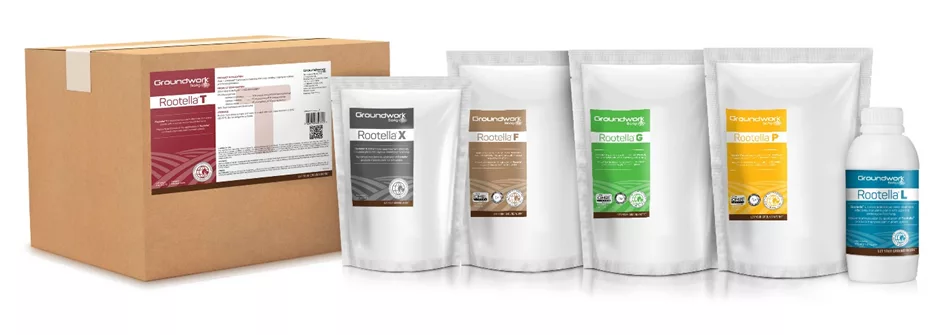
Rootella® mycorrhizal inoculants are highly concentrated, cost-effective soil treatments powered by robust strains of mycorrhizal fungi.
Mycorrhizae form symbiotic partnerships with plant roots, increasing their effective absorptive surface area by several orders of magnitude.
For legumes, this “network of reciprocity” offers a critical biochemical advantage: the coupled processes of phosphorus and nitrogen. While legumes rely on rhizobia to fix nitrogen, rhizobia require phosphorus for optimal functioning. Phosphorus, however, is often chemically “locked” in soil compounds, remaining biologically unavailable to the plant.
Mycorrhizae are capable of facilitating the solubilization of this trapped phosphorus and delivering it directly to plant roots, offering rhizobia the energy they require to process nitrogen. When phosphorus uptake increases, rhizobia activity does too, resulting in improved nodulation and nitrogen fixation. Because mycorrhizae expand root zones, they also act as a “microbial superhighway” for beneficial soil microbes, aiding in nitrogen dispersal throughout the soil.
Rootella Agronomic Co-Benefits: Four Pillars of Performance
Beyond nitrogen fixation, Rootella® offers a broad scope of benefits designed to enhance every aspect of farm success:
- Fertility & Yield: Improved nutrient access means more “bushels in the bin”
- Savings: Optimizing fertilizer efficiency and water retention improves ROI
- Resilience: An extended root zone provides a moisture lifeline during drought and stabilizes plants during flooding
- Carbon: Rootella durably sequesters carbon deep in soil. This builds soil organic matter for long-term cropland fertility, while also offering an immediate carbon income opportunity
Real-World Results: From Kentucky to the Corn Belt
“We are extremely happy with Rootella this year. We are seeing 10-12 bushel per acre increase in our soybean yields.” – Agri Select Kentucky
Performance Data
Multi-state soy trials (Iowa, Nebraska, Mississippi and California) show an average of 3.1 bushel per acre yield increase.
Seamless Integration: No Changes Required
The biologicals market is booming, and with this growth comes some healthy skepticism. Farmers often approach another new biological input wondering if the product may be hard to apply or require equipment adaptations or practice changes. Rootella is available in multiple easy-to-use formulations, including liquid, wettable powder and fine powder. It fits smoothly into all existing seed treatment protocols or as an overtreat on pre-treated seeds. No new equipment or practice changes required.
Let Rootella Unleash Legume Potential
Legumes have the potential to be one of your most profitable, resilient crops. Let Rootella provide the soil infrastructure they need to thrive.
Curious to see what an extended root zone can do for your farm?
Contact Hanan Dor or Andrew Duff to request our latest trial data.
Rootella: Let Your Ground Work


